Check Flag Code of India :
http://mha.nic.in/nationalflag2002.htm
Sunday, August 14, 2005

Jawaharlal Nehru
Nehru, Jawaharlal (jəwähərläl' nā'rū, nĕ'–) , 1889–1964, Indian statesman, b. Allahabad; son of Motilal Nehru. A politician and statesman of great skill, Nehru was enormously popular in India.
Early Career:
Educated in England at Harrow and Cambridge, he was admitted to the English bar in 1912 and practiced law in India for several years. After the massacre at Amritsar (1919), he devoted himself to the struggle for India's freedom. His compelling oratory as well as his close association with Mohandas Gandhi contributed to making him a leader of the Indian National Congress, and in 1929 (the first of four times) he was elected its president.
A leader of the radical wing of the Congress, Nehru spent most of the period from 1930 to 1936 in jail for conducting civil disobedience campaigns. About 1939 disharmony developed between him and Gandhi. Nehru, who had been influenced by a study of Marxism, opposed Gandhi's ideal of an agrarian society and advanced a program calling for the industrialization and socialization of India. During World War II, however, Nehru and Gandhi were united in their opposition to aiding Great Britain unless India was immediately freed, and Nehru was imprisoned from Oct., 1942, to June, 1945. After his release, he participated in the negotiations that led to the creation of the two independent states of India and Pakistan in 1947.
Indian Prime Minister:
Nehru became India's prime minister and minister of foreign affairs and led the country through the difficult early years of independence. The domestic problems of those years included the massive influx of Hindu refugees from Pakistan; the integration of the princely states into the new political structure (Hyderabad was incorporated by force in 1948, and Kashmir's accession caused the first India-Pakistan War, ending in the partition of the state); and controversy and unrest associated with the reorganization of the states on a linguistic basis. On the economic front the government launched a series of five-year plans with the declared goal of achieving a “socialist pattern of society.”
In foreign affairs Nehru adopted a policy of neutralism. He stressed the importance of the movement of nonaligned nations in international politics and became one of its leading spokesmen. He also opposed the formation of military alliances and urged a moratorium on all nuclear testing. Some observers felt that he lost stature as an advocate of peace by employing force in Kashmir and by seizing (1961) Goa from the Portuguese. It also appeared that he might be abandoning strict neutralism for a more pro-Western policy when he requested Western aid to defend India against Chinese border incursions in 1962.
Bibliography :
Nehru wrote voluminously, especially while in prison; his notable works include Glimpses of World History (1936), comprising letters to his daughter (Indira Gandhi), and The Discovery of India (1946). See also his autobiography, Toward Freedom (American ed. 1941, repr. 1958); biographies by M. Edwardes (1971) and S. Gopal (3 vol., 1976–84); B. R. Nanda, The Nehrus (1962).
History:
Nehru, Jawaharlal (juh-wah-huhr-lahl nair-ooh, nay-rooh)
An Indian political leader of the twentieth century. Nehru was a close associate of Mahatma Gandhi in the struggle for independence from Britain in India during the 1930s and 1940s. After independence, he served as the country's first prime minister, steering Indian foreign policy toward nonalignment (see nonaligned nations). Nehru died in 1964.
The noun Jawaharlal Nehru has one meaning:
Meaning #1: Indian statesman and leader with Gandhi in the struggle for home rule; was the first Prime Minister of the Republic of India from 1947 to 1964 (1889-1964)
Jawaharlal Nehru

Brief Biography:
1889-1918 : The son of prominent Congress leader Motilal Nehru, Nehru returned from education in England at Harrow and Trinity College, Cambridge to practice law before following his father into politics. By his parents' arrangement, Nehru married Kamala Kaul, then seventeen in 1916. At the time of his wedding on 8 February, 1916, Jawaharlal was twenty-six, a British educated Barrister. Kamala came from a well-known business family of Kashmiris in Delhi. Jawaharlal was domineering; Kamala quiet and unobtrusive. Despite Jawaharlal's presumably modern views, Kamala was to have very little impact on her petulant husband. In the second year of the marriage, Kamala gave birth to their only child, Indira Priyadarshini in 1917.
1918-1937 : Politically, Nehru gradually emerged as a protege of Mohandas Karamchand Gandhi entering the first rank in Indian nationalist politics as president of Congress (an annual post) for the first time in 1929. Nehru spent most of these years in prison writing books and letters; he lost his father and wife while incarcerated. Kamala Nehru died of tuberculosis on 28 February, 1936 in Switzerland.
1937-1947 : Imprisoned for 32 months after the Quit India movement of 1942, Nehru formed the country's first Indian government in July 1946 in the face of mounting opposition from the All-India Muslim League, whose campaign for a separate state led to the creation of a separate Pakistan in 1947.
Nehru's major rival as Mahatma Gandhi's successor in Congress was Sardar Vallabhai Patel. Nehru was considered more idealistic than the more pragmatic Patel, who was also popular within Congress; but Gandhi's fondness for Nehru proved decisive in all contests between the two leaders.
Another of Nehru's political rivals, this time on the Congress left, was Subhas Chandra Bose who championed a military solution against the British. Bose left the Congress after Gandhi opposed his Presidency at the Tripura Session of Congress in 1937; he went on to found the Indian National Army, which has been referred to as the "Forgotten Army" in a famous book of the same title, and, allied with the Japanese, took part in action against colonial British forces in much of Southeast Asia.
1947-1964 : Nehru served as the prime minister of India for these 18 years consecutively. Nehru died on 27 May, 1964. India's heavy defeat in the war with China, which dimmed his public stature greatly, and affected him greatly both physically and mentally: he felt betrayed by the Chinese, whom he had trusted implicitly and supported in many fora. He died shortly thereafter, having achieved much, yet still - according to a quote from Robert Frost which he had always kept on his office desk - feeling he had so much more left to do.
Nehru's Policies :
Economic Policy : Nehru was fascinated by the Soviet Union's Piatiletka or 5-year plans. But he wrote after a visit there in the 1920s that 'the human costs are unpayable'. A believer in the 'mixed economy' of Harold Laski and influenced by the Fabian Society, Nehru wished the Indian Economy to be partially capitalist, but with the state occupying a large role, especially in the commanding heights of the economy.
In setting a path for the economic policy after Independence, he choose from a set of options considerably more limited than those available today, and followed to a large degree the conventional wisdom among academic economists of the time. India's growth rate in GDP stayed moderately above 4% during all the years that Nehru was Prime Minister.
Some recent (but isolated) studies influence by Chicago School economists—such as one by Goldman Sachs—have claimed that India, had the potential to grow faster than it did in the 1960-1980 timeframe. According to this thinking, that opportunity was wasted out of a misplaced faith in the power of economic planning. Economist Jagdish Bhagwati has remarked that India's problem has been that it has too many brilliant economists; Bhagwati believes the stalwarts of Nehru's Planning Commissions began to believe in their own infallibility, to the detriment of the Indian nation.
B. R. Shenoy contemporary dissent to Nehru's Second Five-Year Plan, notably, is now considered a classic publication in the Austrian School of Economics.
The Soviet Union was the only major power during Nehru's tenure to aid India in developing independent capabilities areas of heavy industry, engineering, and technology. This political fact, combined with Nehru's preference for state-led development, promoted suspicion about the sincerity of India's non-aligned foreign policy positions. In hindsight, the Nehruvian model failed in many of its objectives; however, many Indian economists—particularly among Nehru's contemporaries—believe Nehru's emphasis on central planning was the right policy for India of that time.
Some critics of Indian economic development believe that the economy of the Nehruvian and post-Nehruvian era, with inefficient public sector entities on the one hand, and crony-capitalist private sector entities that used the so-called license raj to carve out lucrative niches for themselves on the other, was a product of economic policy foundations laid during Nehru's tenure.
Nehru's economic policies are sometimes confused by critics with those of his daughter, Indira Gandhi, which were more statist and dirigiste in orientation. Nehru's economics of state intervention and investment were conceived at a time when transfers of capital and technology important to India were not easily forthcoming from the developed world (which at the time also had plenty of state-sponsored capital controls.)
Institutional legacy :
The British left behind civic institutions including the judicial system, parliament and universities that continued to function well during Nehru's tenure.
Foreign Policy : Nehru's personal charisma extended to the world stage where, because of his leadership, India was often seen to be "punching above its weight." As prime minister, he pursued a foreign policy of non-alignment and became a founder and leader of the Non-Aligned Movement. He pursued India's claim to Kashmir in the face of Pakistani opposition, resulting in the First Kashmir War (1947-49). Not wishing to confront China, Nehru did not protest the Chinese conquest of Tibet, despite the fact that it meant the disappearance of a buffer state that had separated China and India, although the Dalai Lama was permitted to set up a government-in-exile at Dharamsala. Military defeat at the hands of the People's Republic of China in the Sino-Indian War in October 1962 brought strong criticism of military unpreparedness and Nehru's policy of excessive trust in China, which had, to its credit, truthfully indicated its intention to occupy both Tibet and parts of northern India.
During the Cold War on November 27, 1946, Nehru appealed to the United States and the Soviet Union to end nuclear testing and to start nuclear disarmament, stating that such an action would "save humanity from the ultimate disaster."
Home Affairs :
Though Nehru professed distaste for armed force, during his administration the Home Minister Sardar Patel used India's army to secure, for instance, Hyderabad in September 1948; later Portuguese-colonized Goa in December 1961 was incorporated into India through a bloodless military takeover.
Books written by Nehru :
Nehru on the Cover of the Discovery of India.Nehru's letters to his daughter Indira during successive periods of imprisonment in 1930-1934 were later compiled into a book called Glimpses of World History.
His 1942-1945 incarceration produced The Discovery of India, a history of India with digressions.
Subsequently, he wrote An Autobiography (ISBN 014303104X), which was a New York Times best seller.
The words of Nehru's famous Tryst with Destiny speech on the eve of Indian Independence is as familiar, and indeed significant, to Indian ears as the Gettysburg Address is to Americans. However, to a modern Indian listening to a tinny recording of that speech, Nehru's famed charisma does not quite come across although he was supposedly a legendary orator.
Post-Nehru era :
His only daughter, Indira Gandhi, went on to become Prime Minister following the death of Nehru's immediate successor Lal Bahadur Shastri in January 1966. In an interview to an American magazine, "My legacy to India", Nehru had said, "is, hopefully, 400 million people capable of governing themselves".

Trivia about NehruNehru had a golden bronze statue of Mahatma Gandhi and a hand of Abraham Lincoln on his office desk.
In 1937, Modern Review of Calcutta carried a letter, under the pen-name Chanakya, that warned members of the Congress Party against Nehru, then party president, declaring that he had "tendencies towards autocracy" and needed to be firmly checked before he "turns into Caesar". It emerged many years later that the letter was written by Nehru himself. Nehru popularized the Nehru jacket.
Nehru's birthday, 14 November, is celebrated as Children's Day in India, in memory of his love of children.
Early Career:
Educated in England at Harrow and Cambridge, he was admitted to the English bar in 1912 and practiced law in India for several years. After the massacre at Amritsar (1919), he devoted himself to the struggle for India's freedom. His compelling oratory as well as his close association with Mohandas Gandhi contributed to making him a leader of the Indian National Congress, and in 1929 (the first of four times) he was elected its president.
A leader of the radical wing of the Congress, Nehru spent most of the period from 1930 to 1936 in jail for conducting civil disobedience campaigns. About 1939 disharmony developed between him and Gandhi. Nehru, who had been influenced by a study of Marxism, opposed Gandhi's ideal of an agrarian society and advanced a program calling for the industrialization and socialization of India. During World War II, however, Nehru and Gandhi were united in their opposition to aiding Great Britain unless India was immediately freed, and Nehru was imprisoned from Oct., 1942, to June, 1945. After his release, he participated in the negotiations that led to the creation of the two independent states of India and Pakistan in 1947.
Indian Prime Minister:
Nehru became India's prime minister and minister of foreign affairs and led the country through the difficult early years of independence. The domestic problems of those years included the massive influx of Hindu refugees from Pakistan; the integration of the princely states into the new political structure (Hyderabad was incorporated by force in 1948, and Kashmir's accession caused the first India-Pakistan War, ending in the partition of the state); and controversy and unrest associated with the reorganization of the states on a linguistic basis. On the economic front the government launched a series of five-year plans with the declared goal of achieving a “socialist pattern of society.”
In foreign affairs Nehru adopted a policy of neutralism. He stressed the importance of the movement of nonaligned nations in international politics and became one of its leading spokesmen. He also opposed the formation of military alliances and urged a moratorium on all nuclear testing. Some observers felt that he lost stature as an advocate of peace by employing force in Kashmir and by seizing (1961) Goa from the Portuguese. It also appeared that he might be abandoning strict neutralism for a more pro-Western policy when he requested Western aid to defend India against Chinese border incursions in 1962.
Bibliography :
Nehru wrote voluminously, especially while in prison; his notable works include Glimpses of World History (1936), comprising letters to his daughter (Indira Gandhi), and The Discovery of India (1946). See also his autobiography, Toward Freedom (American ed. 1941, repr. 1958); biographies by M. Edwardes (1971) and S. Gopal (3 vol., 1976–84); B. R. Nanda, The Nehrus (1962).
History:
Nehru, Jawaharlal (juh-wah-huhr-lahl nair-ooh, nay-rooh)
An Indian political leader of the twentieth century. Nehru was a close associate of Mahatma Gandhi in the struggle for independence from Britain in India during the 1930s and 1940s. After independence, he served as the country's first prime minister, steering Indian foreign policy toward nonalignment (see nonaligned nations). Nehru died in 1964.
The noun Jawaharlal Nehru has one meaning:
Meaning #1: Indian statesman and leader with Gandhi in the struggle for home rule; was the first Prime Minister of the Republic of India from 1947 to 1964 (1889-1964)
Jawaharlal Nehru
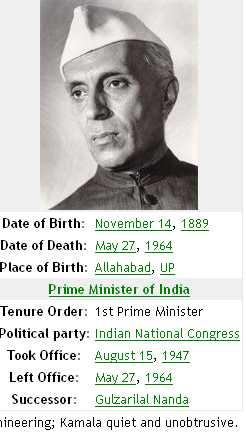
Brief Biography:
1889-1918 : The son of prominent Congress leader Motilal Nehru, Nehru returned from education in England at Harrow and Trinity College, Cambridge to practice law before following his father into politics. By his parents' arrangement, Nehru married Kamala Kaul, then seventeen in 1916. At the time of his wedding on 8 February, 1916, Jawaharlal was twenty-six, a British educated Barrister. Kamala came from a well-known business family of Kashmiris in Delhi. Jawaharlal was domineering; Kamala quiet and unobtrusive. Despite Jawaharlal's presumably modern views, Kamala was to have very little impact on her petulant husband. In the second year of the marriage, Kamala gave birth to their only child, Indira Priyadarshini in 1917.
1918-1937 : Politically, Nehru gradually emerged as a protege of Mohandas Karamchand Gandhi entering the first rank in Indian nationalist politics as president of Congress (an annual post) for the first time in 1929. Nehru spent most of these years in prison writing books and letters; he lost his father and wife while incarcerated. Kamala Nehru died of tuberculosis on 28 February, 1936 in Switzerland.
1937-1947 : Imprisoned for 32 months after the Quit India movement of 1942, Nehru formed the country's first Indian government in July 1946 in the face of mounting opposition from the All-India Muslim League, whose campaign for a separate state led to the creation of a separate Pakistan in 1947.
Nehru's major rival as Mahatma Gandhi's successor in Congress was Sardar Vallabhai Patel. Nehru was considered more idealistic than the more pragmatic Patel, who was also popular within Congress; but Gandhi's fondness for Nehru proved decisive in all contests between the two leaders.
Another of Nehru's political rivals, this time on the Congress left, was Subhas Chandra Bose who championed a military solution against the British. Bose left the Congress after Gandhi opposed his Presidency at the Tripura Session of Congress in 1937; he went on to found the Indian National Army, which has been referred to as the "Forgotten Army" in a famous book of the same title, and, allied with the Japanese, took part in action against colonial British forces in much of Southeast Asia.
1947-1964 : Nehru served as the prime minister of India for these 18 years consecutively. Nehru died on 27 May, 1964. India's heavy defeat in the war with China, which dimmed his public stature greatly, and affected him greatly both physically and mentally: he felt betrayed by the Chinese, whom he had trusted implicitly and supported in many fora. He died shortly thereafter, having achieved much, yet still - according to a quote from Robert Frost which he had always kept on his office desk - feeling he had so much more left to do.
Nehru's Policies :
Economic Policy : Nehru was fascinated by the Soviet Union's Piatiletka or 5-year plans. But he wrote after a visit there in the 1920s that 'the human costs are unpayable'. A believer in the 'mixed economy' of Harold Laski and influenced by the Fabian Society, Nehru wished the Indian Economy to be partially capitalist, but with the state occupying a large role, especially in the commanding heights of the economy.
In setting a path for the economic policy after Independence, he choose from a set of options considerably more limited than those available today, and followed to a large degree the conventional wisdom among academic economists of the time. India's growth rate in GDP stayed moderately above 4% during all the years that Nehru was Prime Minister.
Some recent (but isolated) studies influence by Chicago School economists—such as one by Goldman Sachs—have claimed that India, had the potential to grow faster than it did in the 1960-1980 timeframe. According to this thinking, that opportunity was wasted out of a misplaced faith in the power of economic planning. Economist Jagdish Bhagwati has remarked that India's problem has been that it has too many brilliant economists; Bhagwati believes the stalwarts of Nehru's Planning Commissions began to believe in their own infallibility, to the detriment of the Indian nation.
B. R. Shenoy contemporary dissent to Nehru's Second Five-Year Plan, notably, is now considered a classic publication in the Austrian School of Economics.
The Soviet Union was the only major power during Nehru's tenure to aid India in developing independent capabilities areas of heavy industry, engineering, and technology. This political fact, combined with Nehru's preference for state-led development, promoted suspicion about the sincerity of India's non-aligned foreign policy positions. In hindsight, the Nehruvian model failed in many of its objectives; however, many Indian economists—particularly among Nehru's contemporaries—believe Nehru's emphasis on central planning was the right policy for India of that time.
Some critics of Indian economic development believe that the economy of the Nehruvian and post-Nehruvian era, with inefficient public sector entities on the one hand, and crony-capitalist private sector entities that used the so-called license raj to carve out lucrative niches for themselves on the other, was a product of economic policy foundations laid during Nehru's tenure.
Nehru's economic policies are sometimes confused by critics with those of his daughter, Indira Gandhi, which were more statist and dirigiste in orientation. Nehru's economics of state intervention and investment were conceived at a time when transfers of capital and technology important to India were not easily forthcoming from the developed world (which at the time also had plenty of state-sponsored capital controls.)
Institutional legacy :
The British left behind civic institutions including the judicial system, parliament and universities that continued to function well during Nehru's tenure.
Foreign Policy : Nehru's personal charisma extended to the world stage where, because of his leadership, India was often seen to be "punching above its weight." As prime minister, he pursued a foreign policy of non-alignment and became a founder and leader of the Non-Aligned Movement. He pursued India's claim to Kashmir in the face of Pakistani opposition, resulting in the First Kashmir War (1947-49). Not wishing to confront China, Nehru did not protest the Chinese conquest of Tibet, despite the fact that it meant the disappearance of a buffer state that had separated China and India, although the Dalai Lama was permitted to set up a government-in-exile at Dharamsala. Military defeat at the hands of the People's Republic of China in the Sino-Indian War in October 1962 brought strong criticism of military unpreparedness and Nehru's policy of excessive trust in China, which had, to its credit, truthfully indicated its intention to occupy both Tibet and parts of northern India.
During the Cold War on November 27, 1946, Nehru appealed to the United States and the Soviet Union to end nuclear testing and to start nuclear disarmament, stating that such an action would "save humanity from the ultimate disaster."
Home Affairs :
Though Nehru professed distaste for armed force, during his administration the Home Minister Sardar Patel used India's army to secure, for instance, Hyderabad in September 1948; later Portuguese-colonized Goa in December 1961 was incorporated into India through a bloodless military takeover.
Books written by Nehru :
Nehru on the Cover of the Discovery of India.Nehru's letters to his daughter Indira during successive periods of imprisonment in 1930-1934 were later compiled into a book called Glimpses of World History.
His 1942-1945 incarceration produced The Discovery of India, a history of India with digressions.
Subsequently, he wrote An Autobiography (ISBN 014303104X), which was a New York Times best seller.
The words of Nehru's famous Tryst with Destiny speech on the eve of Indian Independence is as familiar, and indeed significant, to Indian ears as the Gettysburg Address is to Americans. However, to a modern Indian listening to a tinny recording of that speech, Nehru's famed charisma does not quite come across although he was supposedly a legendary orator.
Post-Nehru era :
His only daughter, Indira Gandhi, went on to become Prime Minister following the death of Nehru's immediate successor Lal Bahadur Shastri in January 1966. In an interview to an American magazine, "My legacy to India", Nehru had said, "is, hopefully, 400 million people capable of governing themselves".

Trivia about NehruNehru had a golden bronze statue of Mahatma Gandhi and a hand of Abraham Lincoln on his office desk.
In 1937, Modern Review of Calcutta carried a letter, under the pen-name Chanakya, that warned members of the Congress Party against Nehru, then party president, declaring that he had "tendencies towards autocracy" and needed to be firmly checked before he "turns into Caesar". It emerged many years later that the letter was written by Nehru himself. Nehru popularized the Nehru jacket.
Nehru's birthday, 14 November, is celebrated as Children's Day in India, in memory of his love of children.
Mahatma Gandhi
I AM STARTING WITH THE BIOGRAPHY OF MAHATMA GANDHI-FATHER OF NATION.

Summary Gandhi (1869-1948) , also known as Mahatma Gandhi, was born in Porbandar in the present day state of Gujarat in India on October 2, 1869, and educated in law at University College, London. In 1891, after having been admitted to the British bar, Gandhi returned to India and attempted to establish a law practice in Bombay, with little success. Two years later an Indian firm with interests in South Africa retained him as legal adviser in its office in Durban. Arriving in Durban, Gandhi found himself treated as a member of an inferior race. He was appalled at the widespread denial of civil liberties and political rights to Indian immigrants to South Africa. He threw himself into the struggle for elementary rights for Indians.
Resistance to Injustice :
Gandhi remained in South Africa for 20 years, suffering imprisonment many times. In 1896, after being attacked and beaten by white South Africans, Gandhi began to teach a policy of passive resistance to, and non-cooperation with, the South African authorities. Part of the inspiration for this policy came from the Russian writer Leo Tolstoy, whose influence on Gandhi was profound. Gandhi also acknowledged his debt to the teachings of Christ and to the 19th-century American writer Henry David Thoreau, especially to Thoreau's famous essay "Civil Disobedience." Gandhi considered the terms passive resistance and civil disobedience inadequate for his purposes, however, and coined another term, Satyagraha (Sanskrit, “truth and firmness”). During the Boer War, Gandhi organized an ambulance corps for the British army and commanded a Red Cross unit. After the war he returned to his campaign for Indian rights. In 1910, he founded Tolstoy Farm, near Durban, a cooperative colony for Indians. In 1914 the government of the Union of South Africa made important concessions to Gandhi's demands, including recognition of Indian marriages and abolition of the poll tax for them. His work in South Africa complete, he returned to India.
Campaign for Home Rule :
Gandhi became a leader in a complex struggle, the Indian campaign for home rule. Following World War I, in which he played an active part in recruiting campaigns, Gandhi, again advocating Satyagraha, launched his movement of non-violent resistance to Great Britain. When, in 1919, Parliament passed the Rowlatt Acts, giving the Indian colonial authorities emergency powers to deal with so-called revolutionary activities, Satyagraha spread throughout India, gaining millions of followers. A demonstration against the Rowlatt Acts resulted in a massacre of Indians at Amritsar by British soldiers; in 1920, when the British government failed to make amends, Gandhi proclaimed an organized campaign of non-cooperation. Indians in public office resigned, government agencies such as courts of law were boycotted, and Indian children were withdrawn from government schools. Throughout India, streets were blocked by squatting Indians who refused to rise even when beaten by police. Gandhi was arrested, but the British were soon forced to release him.
Economic independence for India, involving the complete boycott of British goods, was made a corollary of Gandhi's Swaraj (Sanskrit, “self-ruling”) movement. The economic aspects of the movement were significant, for the exploitation of Indian villagers by British industrialists had resulted in extreme poverty in the country and the virtual destruction of Indian home industries. As a remedy for such poverty, Gandhi advocated revival of cottage industries; he began to use a spinning wheel as a token of the return to the simple village life he preached, and of the renewal of native Indian industries.
Gandhi became the international symbol of a free India. He lived a spiritual and ascetic life of prayer, fasting, and meditation. His union with his wife became, as he himself stated, that of a brother and sister. Refusing earthly possessions, he wore the loincloth and shawl of the lowliest Indian and subsisted on vegetables, fruit juices, and goat's milk. Indians revered him as a saint and began to call him Mahatma (great-souled), a title reserved for the greatest sages. Gandhi's advocacy of nonviolence, known as ahimsa (non-violence), was the expression of a way of life implicit in the Hindu religion. By the Indian practice of nonviolence, Gandhi held, Great Britain too would eventually consider violence useless and would leave India.
The Mahatma's political and spiritual hold on India was so great that the British authorities dared not interfere with him. In 1921 the Indian National Congress, the group that spearheaded the movement for nationhood, gave Gandhi complete executive authority, with the right of naming his own successor. The Indian population, however, could not fully comprehend the unworldly ahimsa. A series of armed revolts against Great Britain broke out, culminating in such violence that Gandhi confessed the failure of the civil-disobedience campaign he had called, and ended it. The British government again seized and imprisoned him in 1922.
After his release from prison in 1924, Gandhi withdrew from active politics and devoted himself to propagating communal unity. Unavoidably, however, he was again drawn into the vortex of the struggle for independence. In 1930 the Mahatma proclaimed a new campaign of civil disobedience, calling upon the Indian population to refuse to pay taxes, particularly the tax on salt. The campaign was a march to the sea, in which thousands of Indians followed Gandhi from Ahmedabad to the Arabian Sea, where they made salt by evaporating sea water. Once more the Indian leader was arrested, but he was released in 1931, halting the campaign after the British made concessions to his demands. In the same year Gandhi represented the Indian National Congress at a conference in London.
Gandhi with Followers:
Gandhi takes on Domestic ProblemsIn 1932, Gandhi began new civil-disobedience campaigns against the British. Arrested twice, the Mahatma fasted for long periods several times; these fasts were effective measures against the British, because revolution might well have broken out in India if he had died. In September 1932, while in jail, Gandhi undertook a “fast unto death” to improve the status of the Hindu Untouchables. The British, by permitting the Untouchables to be considered as a separate part of the Indian electorate, were, according to Gandhi, countenancing an injustice. Although he was himself a member of the Vaishya (merchant) caste, Gandhi was the great leader of the movement in India dedicated to eradicating the unjust social and economic aspects of the caste system.
In 1934 Gandhi formally resigned from politics, being replaced as leader of the Congress party by Jawaharlal Nehru. Gandhi traveled through India, teaching ahimsa and demanding eradication of "untouchability." The esteem in which he was held was the measure of his political power. So great was this power that the limited home rule granted by the British in 1935 could not be implemented until Gandhi approved it. A few years later, in 1939, he again returned to active political life because of the pending federation of Indian principalities with the rest of India. His first act was a fast, designed to force the ruler of the state of Rajkot to modify his autocratic rule. Public unrest caused by the fast was so great that the colonial government intervened; the demands were granted. The Mahatma again became the most important political figure in India.
Man of Firm Step:
Independence for IndiaWhen World War II broke out, the Congress party and Gandhi demanded a declaration of war aims and their application to India. As a reaction to the unsatisfactory response from the British, the party decided not to support Britain in the war unless the country were granted complete and immediate independence. The British refused, offering compromises that were rejected. When Japan entered the war, Gandhi still refused to agree to Indian participation. He was interned in 1942 but was released two years later because of failing health.
By 1944 the Indian struggle for independence was in its final stages, the British government having agreed to independence on condition that the two contending nationalist groups, the Muslim League and the Congress party, should resolve their differences. Gandhi stood steadfastly against the partition of India but ultimately had to agree, in the hope that internal peace would be achieved after the Muslim demand for separation had been satisfied. India and Pakistan became separate states when the British granted India its independence in 1947 (see: Tryst with Destiny -- the story of India's independence). During the riots that followed the partition of India, Gandhi pleaded with Hindus and Muslims to live together peacefully. Riots engulfed Calcutta, one of the largest cities in India, and the Mahatma fasted until disturbances ceased. On January 13, 1948, he undertook another successful fast in New Delhi to bring about peace, but on January 30, 12 days after the termination of that fast, as he was on his way to his evening prayer meeting, he was assassinated by a fanatic Hindu.
Gandhi's death was regarded as an international catastrophe. His place in humanity was measured not in terms of the 20th century, but in terms of history. A period of mourning was set aside in the United Nations General Assembly, and condolences to India were expressed by all countries. Religious violence soon waned in India and Pakistan, and the teachings of Gandhi came to inspire nonviolent movements elsewhere, notably in the U.S. under the civil rights leader Martin Luther King, Jr. and in South Africa under Nelson Mandela.

Summary Gandhi (1869-1948) , also known as Mahatma Gandhi, was born in Porbandar in the present day state of Gujarat in India on October 2, 1869, and educated in law at University College, London. In 1891, after having been admitted to the British bar, Gandhi returned to India and attempted to establish a law practice in Bombay, with little success. Two years later an Indian firm with interests in South Africa retained him as legal adviser in its office in Durban. Arriving in Durban, Gandhi found himself treated as a member of an inferior race. He was appalled at the widespread denial of civil liberties and political rights to Indian immigrants to South Africa. He threw himself into the struggle for elementary rights for Indians.
Resistance to Injustice :
Gandhi remained in South Africa for 20 years, suffering imprisonment many times. In 1896, after being attacked and beaten by white South Africans, Gandhi began to teach a policy of passive resistance to, and non-cooperation with, the South African authorities. Part of the inspiration for this policy came from the Russian writer Leo Tolstoy, whose influence on Gandhi was profound. Gandhi also acknowledged his debt to the teachings of Christ and to the 19th-century American writer Henry David Thoreau, especially to Thoreau's famous essay "Civil Disobedience." Gandhi considered the terms passive resistance and civil disobedience inadequate for his purposes, however, and coined another term, Satyagraha (Sanskrit, “truth and firmness”). During the Boer War, Gandhi organized an ambulance corps for the British army and commanded a Red Cross unit. After the war he returned to his campaign for Indian rights. In 1910, he founded Tolstoy Farm, near Durban, a cooperative colony for Indians. In 1914 the government of the Union of South Africa made important concessions to Gandhi's demands, including recognition of Indian marriages and abolition of the poll tax for them. His work in South Africa complete, he returned to India.
Campaign for Home Rule :
Gandhi became a leader in a complex struggle, the Indian campaign for home rule. Following World War I, in which he played an active part in recruiting campaigns, Gandhi, again advocating Satyagraha, launched his movement of non-violent resistance to Great Britain. When, in 1919, Parliament passed the Rowlatt Acts, giving the Indian colonial authorities emergency powers to deal with so-called revolutionary activities, Satyagraha spread throughout India, gaining millions of followers. A demonstration against the Rowlatt Acts resulted in a massacre of Indians at Amritsar by British soldiers; in 1920, when the British government failed to make amends, Gandhi proclaimed an organized campaign of non-cooperation. Indians in public office resigned, government agencies such as courts of law were boycotted, and Indian children were withdrawn from government schools. Throughout India, streets were blocked by squatting Indians who refused to rise even when beaten by police. Gandhi was arrested, but the British were soon forced to release him.
Economic independence for India, involving the complete boycott of British goods, was made a corollary of Gandhi's Swaraj (Sanskrit, “self-ruling”) movement. The economic aspects of the movement were significant, for the exploitation of Indian villagers by British industrialists had resulted in extreme poverty in the country and the virtual destruction of Indian home industries. As a remedy for such poverty, Gandhi advocated revival of cottage industries; he began to use a spinning wheel as a token of the return to the simple village life he preached, and of the renewal of native Indian industries.
Gandhi became the international symbol of a free India. He lived a spiritual and ascetic life of prayer, fasting, and meditation. His union with his wife became, as he himself stated, that of a brother and sister. Refusing earthly possessions, he wore the loincloth and shawl of the lowliest Indian and subsisted on vegetables, fruit juices, and goat's milk. Indians revered him as a saint and began to call him Mahatma (great-souled), a title reserved for the greatest sages. Gandhi's advocacy of nonviolence, known as ahimsa (non-violence), was the expression of a way of life implicit in the Hindu religion. By the Indian practice of nonviolence, Gandhi held, Great Britain too would eventually consider violence useless and would leave India.
The Mahatma's political and spiritual hold on India was so great that the British authorities dared not interfere with him. In 1921 the Indian National Congress, the group that spearheaded the movement for nationhood, gave Gandhi complete executive authority, with the right of naming his own successor. The Indian population, however, could not fully comprehend the unworldly ahimsa. A series of armed revolts against Great Britain broke out, culminating in such violence that Gandhi confessed the failure of the civil-disobedience campaign he had called, and ended it. The British government again seized and imprisoned him in 1922.
After his release from prison in 1924, Gandhi withdrew from active politics and devoted himself to propagating communal unity. Unavoidably, however, he was again drawn into the vortex of the struggle for independence. In 1930 the Mahatma proclaimed a new campaign of civil disobedience, calling upon the Indian population to refuse to pay taxes, particularly the tax on salt. The campaign was a march to the sea, in which thousands of Indians followed Gandhi from Ahmedabad to the Arabian Sea, where they made salt by evaporating sea water. Once more the Indian leader was arrested, but he was released in 1931, halting the campaign after the British made concessions to his demands. In the same year Gandhi represented the Indian National Congress at a conference in London.
Gandhi with Followers:
Gandhi takes on Domestic ProblemsIn 1932, Gandhi began new civil-disobedience campaigns against the British. Arrested twice, the Mahatma fasted for long periods several times; these fasts were effective measures against the British, because revolution might well have broken out in India if he had died. In September 1932, while in jail, Gandhi undertook a “fast unto death” to improve the status of the Hindu Untouchables. The British, by permitting the Untouchables to be considered as a separate part of the Indian electorate, were, according to Gandhi, countenancing an injustice. Although he was himself a member of the Vaishya (merchant) caste, Gandhi was the great leader of the movement in India dedicated to eradicating the unjust social and economic aspects of the caste system.
In 1934 Gandhi formally resigned from politics, being replaced as leader of the Congress party by Jawaharlal Nehru. Gandhi traveled through India, teaching ahimsa and demanding eradication of "untouchability." The esteem in which he was held was the measure of his political power. So great was this power that the limited home rule granted by the British in 1935 could not be implemented until Gandhi approved it. A few years later, in 1939, he again returned to active political life because of the pending federation of Indian principalities with the rest of India. His first act was a fast, designed to force the ruler of the state of Rajkot to modify his autocratic rule. Public unrest caused by the fast was so great that the colonial government intervened; the demands were granted. The Mahatma again became the most important political figure in India.
Man of Firm Step:
Independence for IndiaWhen World War II broke out, the Congress party and Gandhi demanded a declaration of war aims and their application to India. As a reaction to the unsatisfactory response from the British, the party decided not to support Britain in the war unless the country were granted complete and immediate independence. The British refused, offering compromises that were rejected. When Japan entered the war, Gandhi still refused to agree to Indian participation. He was interned in 1942 but was released two years later because of failing health.
By 1944 the Indian struggle for independence was in its final stages, the British government having agreed to independence on condition that the two contending nationalist groups, the Muslim League and the Congress party, should resolve their differences. Gandhi stood steadfastly against the partition of India but ultimately had to agree, in the hope that internal peace would be achieved after the Muslim demand for separation had been satisfied. India and Pakistan became separate states when the British granted India its independence in 1947 (see: Tryst with Destiny -- the story of India's independence). During the riots that followed the partition of India, Gandhi pleaded with Hindus and Muslims to live together peacefully. Riots engulfed Calcutta, one of the largest cities in India, and the Mahatma fasted until disturbances ceased. On January 13, 1948, he undertook another successful fast in New Delhi to bring about peace, but on January 30, 12 days after the termination of that fast, as he was on his way to his evening prayer meeting, he was assassinated by a fanatic Hindu.
Gandhi's death was regarded as an international catastrophe. His place in humanity was measured not in terms of the 20th century, but in terms of history. A period of mourning was set aside in the United Nations General Assembly, and condolences to India were expressed by all countries. Religious violence soon waned in India and Pakistan, and the teachings of Gandhi came to inspire nonviolent movements elsewhere, notably in the U.S. under the civil rights leader Martin Luther King, Jr. and in South Africa under Nelson Mandela.

Subscribe to:
Posts (Atom)